England Fall Again
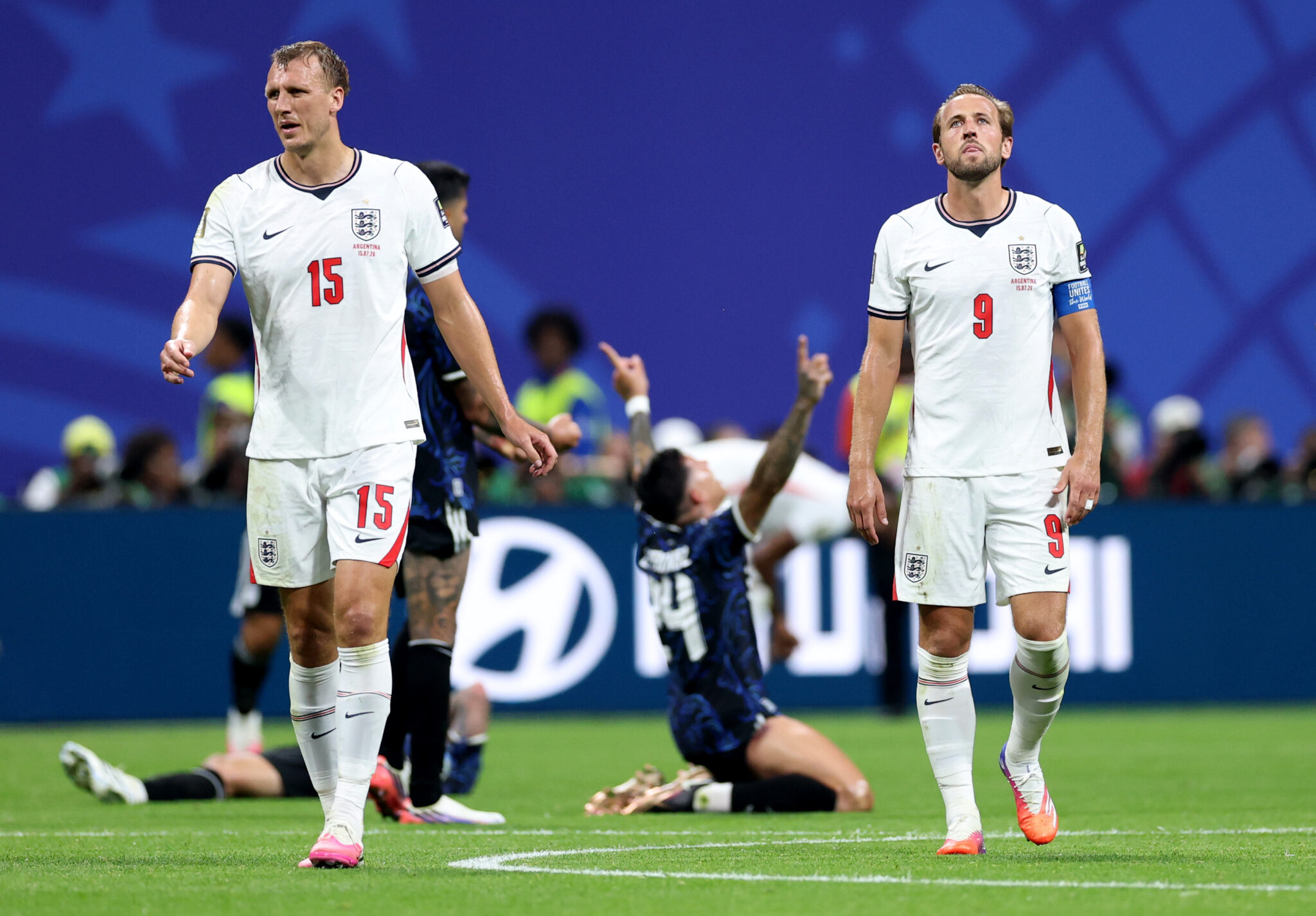
Now that the tears have mostly dried, it feels important to analyse England’s defeat against Messi’s Argentina. Still, before we get tactical, all I’ll say is that Argentina were lucky to have only 3 yellow cards, and that the fact that Simeone or Enzo didn’t get one shocks me; one can only suspect cheating or some sort of favouritism. Regardless, these are all excuses to avoid the main point: that England capitulated.

Now, if we look at how the lineups mesh, the flaws pointed out earlier become even more obvious. Kane does not have the legs to press three players; almost no one does, but he was tired and is slow when he’s fresh. Having a player like Rashford would’ve put the defenders under more pressure, but in this shape, the three centre-backs were able to shift it around, and one of the three, normally Montiel or Otamendi, could make their way into the midfield to create an overload. Furthermore, it meant that O’Reilly or Bellingham would often get dragged out of position following a midfielder or pressing a defender, which meant one of the back five had to cover the gap, and so the back 5 was now a disjointed back four. Personally, I think Tuchel should’ve stayed with a back 4 and told Anderson to follow Messi everywhere, like Mourinho did with Herrera and Hazard in April of 2017. Herrera neutralised Chelsea’s biggest threat and won MOTM in a 2-0 win. With a back four and 5 midfielders, Argentina wouldn’t have been able to commit so many players forward and therefore would have suffered if they had stuck to a 3-3-4 formation.


Of course, the fault isn’t only in the formation, but in the mentality, and there are two parts to that. Firstly, going into a low block with over half an hour left of the game is what Southgate would’ve done, and Tuchel panicked and did exactly what his predecessor would’ve done, exactly what we were made to believe Tuchel wouldn’t do. The second part of the mentality issue is the mentality that comes with playing a back 5. 5-at-the-back is often a false friend, a formation that makes you think you are more solid, but actually makes you more lazy because you assume someone else is covering you.

If we examine this freeze frame just before Lautaro’s goal, we see that he is standing between Konsa and Stones as the cross is about to come in. About 5 seconds before this, Elliot Anderson is marking him, but moves away to cover the centre of the box. Konsa sees him move away, but Stones, with his back turned, does not. In this instant, there are three key failures. At no point before the cross comes in does Stones check his shoulders to see who is behind him, meaning he is too far away from Lautaro to challenge when the cross comes in. The second failure is that Konsa, who has seen Anderson move away and can see Lautaro, doesn’t get the message to Stones to take a few steps back, but Konsa also doesn’t move, leaving Lautaro open. And the final failure is when Anderson moves away, he fails to communicate with his teammates that he is going to mark the space, and someone must mark the player he has moved away from. This combination, plus an incredible cross from Messi, leads to Lautaro having a free header and tucking it away nicely.
A final word, though, must come about squad selection, and one key choice in particular. When Tino Livramento pulled out of the squad through injury, Thomas Tuchel called up Trevoh Chalobah to replace him. Chalobah played zero minutes at this tournament, and whilst I am no great fan of Alexander-Arnold, even I can recognise his quality. Because even when James was injured, the backup right-back was Quansah, and then Konsa, it makes no sense why Chalobah was even called up if it was almost guaranteed he wasn’t going to play. In the dying minutes with England trailing, Ezri Konsa put three crosses into the box, all of which hit the first man. A player like Trent would have been amazing to bring on, because you can almost guarantee that his crosses would almost all be on the money.
Furthermore, picking Eze just because he won the league over someone who had a genuinely good season in Gibbs-White, and taking Mainoo only to not play him, and not even taking Palmer or Foden, two players who had poor seasons, but who we know can produce magical moments. Don’t even get me started on Madueke. I may be biased, but even Rio would’ve offered more than Madueke. The squad selection left a lot to be desired, and it was glossed over as England progressed to the semi-finals. Now that we have come crashing out, I think it is important to bring these questions back.
England has fallen short yet again. I have tried and failed to hold back tears for yet another tournament, and the question really should be: do England have what it takes to go all the way, regardless of who the manager is?
Personally Bellingham can do me over multiple times
ReplyDeleteGreat analysis as always, I do believe it was our fault (tuchels). We should've kept our foot on the gas and got another goal with our momentum. Tuchel killed it by parking the bus.
ReplyDeleteArmchair Pundit replaces Tuchel for World Cup 2030?
ReplyDeleteA great analysis…. Such a disappointing loss!
ReplyDeleteReally well written analysis and good technical breakdown. Looking forward to reading your next post
ReplyDelete